Application-State-Aware Cryptographic Key Rotation: A New Security Layer
What This Is and What It Is Not
This system does NOT claim to:
- Invent new cryptographic algorithms
- Replace or improve upon established encryption standards
- Break or weaken any existing security protocols
- Provide “unbreakable” or “military-grade” security marketing claims
- Use proprietary or secret cryptographic methods
This system DOES:
- Add an application-awareness layer to existing, proven cryptographic standards
- Optimize the timing of key rotation based on application state
- Use only well-established, peer-reviewed cryptographic primitives (ECDH, AES-GCM, HKDF, SHA-2)
- Address a specific operational problem: packet loss during key rotation in file transfer systems
- Provide additional security monitoring through entropy analysis
The innovation is in coordination and timing, not in cryptography itself.
Background: Key Rotation in Modern Systems
Cryptographic key rotation is a fundamental security practice in data transfer systems. Protocols like TLS 1.3, WireGuard, and QUIC, as well as commercial file transfer solutions, rotate encryption keys periodically to maintain forward secrecy and limit exposure from potential key compromise.
Current implementations typically use two triggering mechanisms:
- Time-based: Rotate after a fixed interval (e.g., 60-120 seconds)
- Volume-based: Rotate after a certain number of packets or data volume
These approaches operate independently of application activity, which can result in rotations occurring during active file transfers, potentially causing packet loss or brief interruptions.
A New Approach: Application-State Awareness
A patent pending describes a key rotation system that incorporates application state into rotation decisions. This approach adds a security layer that monitors both cryptographic requirements and application activity.
The Six-Priority Framework
The system evaluates rotation timing using a hierarchical priority structure:
Application-State-Aware Priorities:
- User idle detection (monitors user activity periods)
- Transfer completion detection (monitors transfer queue status)
- Individual file completion (monitors transfer activity state)
Traditional Priorities (Fallback): 4. Time-based thresholds 5. Packet count thresholds
Before any rotation occurs, the system performs a safety check verifying no active transfers, no pending queue items, and sufficient idle time since the last packet.
Decision Flow: When to Rotate Keys
To illustrate how the hierarchical priority system works in practice, here is the complete decision flowchart for the file transfer channel (see separate flowchart artifact):
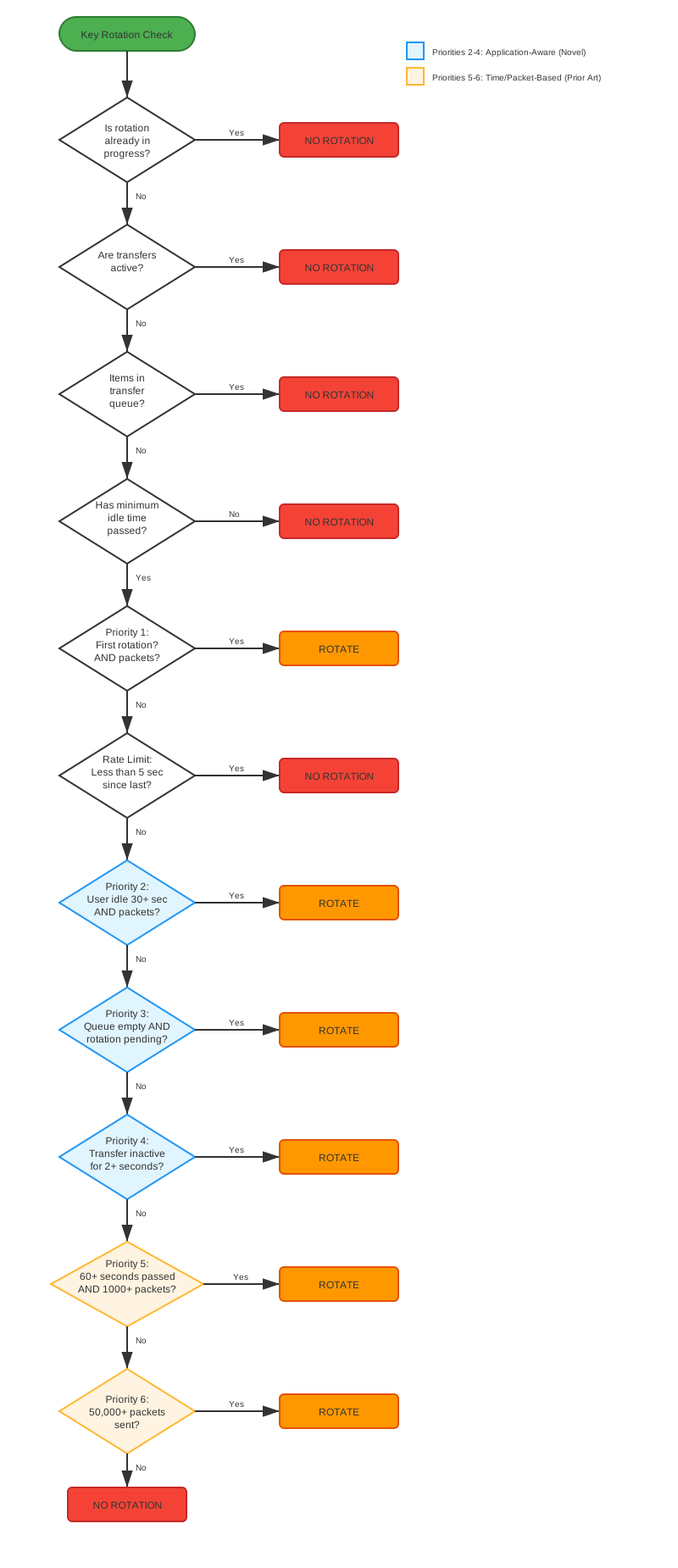
Note. This demonstrate that every channel has their own flow decisions instance and if the packets exceeds the thresholds during mid-transfer, the key roration will occur seemlessly. This to maintain or ensures strong security for the data using the UDP protocol.
Why This Flow Chart Matters:
This is not a vague “proprietary algorithm”—it’s a transparent decision tree that can be:
- Analyzed: Each condition is clearly defined and measurable
- Verified: Implementation can be audited against this specification
- Tested: Each branch can be unit tested independently
- Compared: Directly comparable to TLS 1.3 (uses only priorities 5-6) and WireGuard (uses only priority 5)
The flow chart demonstrates that this is not “magic” or obscure—it’s a documented, verifiable state machine using well-defined conditions. The novelty is in checking application state (priorities 2-4) before falling back to standard time/packet triggers (priorities 5-6).
Multi-Source Entropy Monitoring
Beyond rotation timing, the system collects entropy from multiple sources during operation:
- Network timing characteristics
- Cryptographic operation timing
- Hardware events
- Application behavior patterns
This entropy is used to generate session fingerprints. By analyzing statistical variations between consecutive fingerprints (Hamming distance analysis), the system can detect anomalies that may indicate security concerns between rotation events.
Cryptographic Protocols and Practices
The system functions as an application-aware security layer that can work alongside existing secure transport protocols. It implements standard cryptographic practices:
Transport Layer Context: The patent describes application to secure data transfer systems, which may include:
- Custom secure transport implementations
- Application-layer security over UDP/TCP
- File transfer protocols requiring session-based encryption
- Real-time data streaming with encryption requirements
Key Agreement Protocol:
- ECDH (Elliptic Curve Diffie-Hellman): Ephemeral key agreement for each session
- Supported Curves: Standard NIST curves including secp384r1 (SECG/NIST P-384)
- Perfect Forward Secrecy (PFS): Each rotation generates new ephemeral keys, ensuring past sessions remain secure even if future keys are compromised
- Note: The system uses ECDH rather than RSA for key agreement due to PFS requirements and efficiency
Certificate and Authentication: The focus is on the key rotation mechanism itself rather than initial authentication but with a cetificate pining verification/validation for X.509/PKI. In practice, such systems may:
- Use certificates for initial authentication
- Implement pre-shared keys
- Use other authentication mechanisms
Key Derivation Function (KDF):
- HKDF (HMAC-based KDF): RFC 5869 standard for key derivation
- Hash Functions: SHA-256 (256-bit) and SHA-384 (384-bit) from SHA-2 family
- Key Separation: Derives distinct encryption keys and authentication keys from shared secret
- Salt and Info Parameters: Uses session-specific context for key derivation
Symmetric Encryption:
- AES-GCM (Advanced Encryption Standard – Galois/Counter Mode): YES, this is used
- Authenticated Encryption with Associated Data (AEAD)
- Provides both confidentiality and integrity
- 128-bit or 256-bit AES key sizes
- IV/Nonce Management: Proper initialization vector handling to prevent reuse
- Authentication Tags: GCM generates authentication tags for integrity verification
Message Authentication:
- HMAC (Hash-based Message Authentication Code): For additional authentication layers
- GCM Authentication: Built-in authentication in AES-GCM mode
- Tag Verification: Ensures message integrity and authenticity
Entropy and Random Number Generation:
- OS PRNG: Platform-provided cryptographically secure random number generators
- Linux: /dev/urandom or getrandom()
- Windows: CryptGenRandom or BCryptGenRandom
- Multi-Source Entropy: Supplements OS RNG with timing entropy from:
- Network packet arrival timing (jitter)
- Cryptographic operation timing variations
- Hardware events (garbage collection, memory allocation)
- Application behavior patterns (transfer timing)
- Fingerprint Generation: Creates 32-byte session fingerprints from entropy pool (512 bytes)
Session Management:
- Session Keys: Separate encryption and decryption keys per session
- Key Lifecycle: Generation → Active Use → Rotation → Secure Destruction
- Key Material Destruction: Explicit zeroing of key material after rotation
Atomic Rotation Protocol: The system implements a three-phase rotation protocol:
- Key Generation Phase: New ephemeral ECDH key pair generation
- Atomic Swap Phase: 1-2ms critical section for key replacement
- Verification Phase:
- Encrypt test data with new keys
- Decrypt to verify correctness
- Rollback to backup keys if verification fails
- Cleanup Phase: Secure destruction of old key material
Security Monitoring:
- Hamming Distance Analysis: Statistical analysis of entropy fingerprints
- Low Hamming distance (< threshold): Potential replay attack
- High Hamming distance (> threshold): Potential state tampering
- Continuous Monitoring: Fingerprint generation at regular intervals during transfers
- Anomaly Detection: Deviation from expected entropy patterns
Relationship to Standard Protocols:
The patent describes this as a layer that addresses limitations in existing protocols’ rotation mechanisms:
| Protocol | Key Agreement | Rotation Trigger | Application Awareness |
|---|---|---|---|
| TLS 1.3 | ECDHE | Time + packet count | No |
| WireGuard | Noise Protocol (DH) | Fixed 120s timer | No |
| QUIC | TLS 1.3 handshake | Time + packet count | No |
| DTLS 1.3 | ECDHE | Time-based | No |
| This System | ECDH | 6 priorities (app-aware) | Yes |
Standards Compliance:
- NIST FIPS 186-4: Elliptic curve cryptography
- RFC 5869: HKDF specification
- NIST SP 800-38D: AES-GCM specification
- RFC 2104: HMAC specification
- NIST SP 800-90A: Random number generation recommendations
Critical Security Note: This system uses only standardized, publicly reviewed cryptographic algorithms. It does not:
- Implement custom encryption algorithms
- Use obscure or proprietary cryptographic methods
- Rely on “security through obscurity”
- Claim to enhance the cryptographic strength of AES, ECDH, or other primitives
- Modify the mathematical foundations of established algorithms
The cryptographic security relies entirely on proven standards (AES-256, SHA-384, ECDH with NIST curves). The patent covers the application-aware coordination layer, not the cryptography itself.
Safety Validation: The system includes explicit safety checks that prevent rotation when:
- File transfers are actively in progress
- Transfer queue contains pending items
- Insufficient idle time has elapsed
Comparison with Existing Systems
| System | Triggers Used | Application Awareness |
|---|---|---|
| TLS 1.3 | Time + packet count | No |
| WireGuard | Fixed timer (120s) | No |
| QUIC | Time + packet count | No |
| This System | 6 priorities including app state | Yes |
Practical Implications
The patent describes test results showing packet loss reduction of 50-95% compared to fixed-interval rotation systems in file transfer scenarios. This improvement comes from rotating during application-detected idle periods rather than during active transfers.
Important Limitation: This system does not make the cryptography itself stronger. The security of encrypted data still depends entirely on:
- The strength of AES-256 encryption
- The security of ECDH key agreement
- Proper implementation of these standards
- Protection of key material in memory
What it does provide:
- Operational improvement: Fewer disruptions during file transfers
- Attack detection capability: Continuous monitoring between rotations through entropy analysis
- Session resilience: Automatic recovery from failed rotations
The multi-source entropy monitoring provides continuous security assessment between rotations, adding a layer of attack detection capability not typically present in time-based rotation systems.
Security Layer Concept
This approach functions as a security layer that sits between the application and cryptographic subsystems:
- Monitors application state and user activity
- Coordinates rotation timing with application workload
- Detects anomalous patterns through entropy analysis
- Maintains session integrity through verified rotation
Rather than replacing existing cryptographic protocols, it augments them with application context awareness.
Technical Innovation Areas
The patent pending innovation identifies three key innovation areas:
- Predictive State Machine: Hierarchical evaluation of rotation conditions with application-state priorities
- Not a cryptographic innovation: Uses standard key rotation
- The innovation: Timing coordination based on application state
- Multi-Dimensional Entropy: Continuous security monitoring using multiple entropy sources
- Not a cryptographic innovation: Uses standard entropy collection
- The innovation: Anomaly detection through fingerprint analysis
- Verified Atomic Rotation: Key swap with testing and automatic rollback capability
- Not a cryptographic innovation: Uses standard key exchange
- The innovation: Session continuity during rotation failures
What This System Does Not Do:
- Does not claim faster encryption than AES
- Does not claim stronger security than established algorithms
- Does not use secret or proprietary cryptographic methods
- Does not claim to prevent all attacks or guarantee security
- Does not modify the mathematical basis of cryptographic primitives
What This System Does:
- Reduces operational disruption (packet loss) during key rotation
- Provides application-aware timing for security operations
- Adds continuous monitoring capability between rotation events
- Maintains session continuity when rotation issues occur
Conclusion
Application-state-aware key rotation represents an approach to addressing the tension between security requirements (regular key rotation) and operational efficiency (minimizing transfer disruption). By incorporating application context into rotation decisions, this security layer aims to maintain cryptographic best practices while reducing operational impact.
The system described in the patent pending innovation demonstrates how monitoring application state, combined with multi-source security monitoring and verified rotation procedures, can enhance both security and reliability in data transfer systems.
Final Important Notes:
Security Foundation:
- All cryptographic security depends on standard, peer-reviewed algorithms (AES-256, ECDH, SHA-384)
- No proprietary cryptography is used
- The system cannot make weak cryptography strong
- Proper key management and implementation remain critical
What Makes This Different:
- Application-state awareness for rotation timing (not found in TLS 1.3, WireGuard, QUIC)
- Continuous entropy monitoring for anomaly detection
- Verified rotation with automatic rollback
Honest Assessment: This system addresses a specific problem: coordinating cryptographic operations with application state to reduce disruption and add monitoring capability. It does not claim to revolutionize cryptography or provide unprecedented security. It is a coordination layer built on proven cryptographic foundations.
For Security Professionals: The system can be evaluated based on:
- Use of standard cryptographic primitives (verifiable through standards compliance)
- Application-state monitoring implementation (described in patent)
- Entropy collection and analysis methods (statistical, not cryptographic)
- Operational benefits in specific use cases (file transfer systems)
This is engineering work to solve an operational problem using established cryptography, not a claim of cryptographic breakthrough.
This blog post describes technology covered by patent pending innovation. Technical details are simplified for general audience understanding. The security of this system depends entirely on proper implementation of established cryptographic standards.